
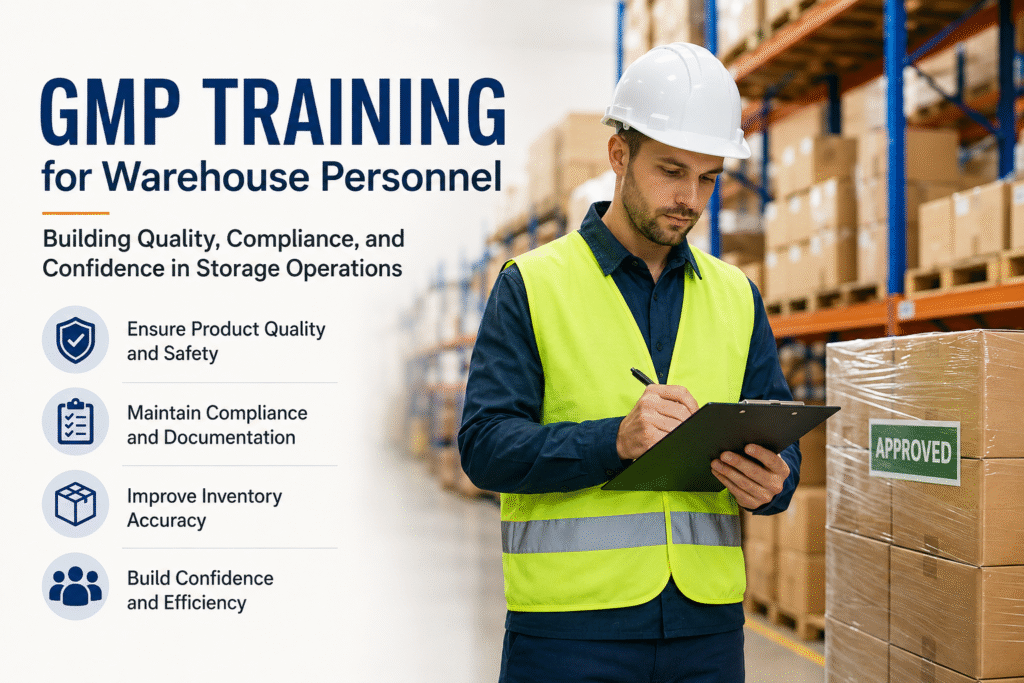
A Warehouse Does More Than Store Products
When people think about manufacturing quality, they often picture production lines, laboratory testing, or quality inspections. Yet a significant part of product quality depends on what happens inside the warehouse. Products that are perfectly manufactured can still face quality issues if they are stored, handled, or distributed incorrectly. That is why GMP Training has become a critical requirement for warehouse personnel across many industries.
For warehouse teams, every pallet moved, every shipment received, and every item dispatched contributes to product integrity. Proper GMP Training helps employees understand how their daily actions affect safety, quality, and regulatory compliance. It creates a culture where quality is not viewed as someone else’s responsibility but as a shared commitment throughout the facility.
Why GMP Training Matters More Than Many People Realize
Warehouse operations may seem straightforward at first glance. Goods arrive, products are stored, and orders are shipped. However, behind these routine activities lies a complex process that directly affects product quality.
Good Manufacturing Practices, commonly known as GMP, establish guidelines that ensure products remain safe and suitable for their intended use. Warehouse personnel play a direct role in maintaining these standards. A misplaced product, incorrect labeling, or failure to follow storage requirements can create significant compliance concerns.
This is where GMP Training makes a difference. It provides employees with the knowledge needed to handle materials correctly while reducing risks that could affect customers, businesses, and regulatory compliance.
Understanding the Foundation of GMP in Warehousing
At its core, GMP Training teaches warehouse personnel how to maintain product quality throughout storage and distribution activities. The goal is simple but important—protect products from damage, contamination, mix-ups, and deterioration.
Training programs typically explain how warehouse activities connect to broader quality systems. Employees learn that quality does not begin or end in production. It continues throughout transportation, storage, inventory management, and distribution.
Think of a warehouse as a bridge. If the bridge is weak, even the highest-quality product may not safely reach its destination. Strong GMP Compliance helps ensure that bridge remains reliable every day.
Receiving Goods: The First Quality Checkpoint
The receiving area serves as the starting point for warehouse quality control. Every shipment entering the facility should be verified according to established procedures. Personnel must confirm product identity, inspect packaging conditions, and review accompanying documentation.
Through GMP Training, employees learn how to identify damaged shipments, missing labels, or discrepancies between received goods and purchase records. These seemingly small checks can prevent larger problems later.
You know what? Many warehouse issues begin at receiving but only become visible weeks later. That is why careful inspection at this stage is so valuable. A few extra minutes spent verifying materials can save considerable time and resources later.
Storage Practices That Protect Product Integrity
Proper storage is one of the most important aspects of Warehouse GMP Training. Products often require specific environmental conditions to maintain their quality. Temperature, humidity, cleanliness, and organization all play a role.
Personnel are trained to understand storage requirements and monitor conditions consistently. They also learn how to separate approved, quarantined, rejected, and returned materials. This separation reduces confusion and helps prevent accidental use or shipment of unsuitable products.
A well-organized warehouse is more than visually appealing. It supports Quality Management Systems and creates a safer, more efficient working environment for everyone involved.
The Importance of Documentation and Record Keeping
Some employees initially view documentation as unnecessary paperwork. Then they discover how valuable accurate records become during audits, investigations, and daily operations.
GMP Training emphasizes the importance of maintaining complete and accurate records. Every transaction, movement, inspection, and storage activity should be documented according to company procedures.
Documentation serves several purposes:
- Supports product traceability
- Demonstrates regulatory compliance
- Helps identify operational issues
- Provides evidence during audits
Good records tell the story of a product’s journey through the warehouse. Without them, even well-executed processes become difficult to verify.
Preventing Contamination and Cross-Contamination
One of the primary goals of GMP Standards is preventing contamination. Warehouse personnel must understand how contamination can occur and how simple actions can reduce risks.
Training often covers personal hygiene, cleaning procedures, pest control, waste management, and material segregation. Employees learn how contaminants can enter storage areas through damaged packaging, poor housekeeping, or improper handling practices.
Interestingly, contamination risks are not always obvious. Something as simple as placing incompatible materials too close together can create problems. Effective GMP Training helps employees recognize these risks before they affect product quality.
Inventory Control and Stock Rotation Made Simple
Inventory management is another critical element of warehouse compliance. Products should be stored and rotated according to established procedures to prevent expiration, deterioration, or unnecessary waste.
Personnel are trained on methods such as FIFO (First In, First Out) and FEFO (First Expired, First Out). These systems help ensure older stock is used or distributed before newer inventory when appropriate.
A warehouse operating under strong GMP Requirements treats inventory control as more than counting products. It becomes part of a larger quality assurance effort designed to protect customers and maintain product effectiveness.
Handling Deviations and Unexpected Situations
No warehouse operates perfectly every day. Shipments arrive damaged. Labels become detached. Equipment occasionally fails. Human errors happen.
The difference lies in how these situations are handled.
GMP Training teaches personnel to identify, report, and document deviations promptly. Employees learn that reporting issues is not about assigning blame. It is about protecting quality and preventing problems from escalating.
When warehouse teams understand corrective and preventive actions, they become active contributors to continuous improvement rather than passive observers.
Preparing for Audits Without Stress
Many employees feel nervous when they hear the word audit. Yet facilities with strong GMP Training Programs often approach audits with confidence because compliance becomes part of daily operations.
Training helps personnel understand auditor expectations, documentation requirements, and standard operating procedures. Instead of scrambling to prepare for inspections, warehouse teams maintain readiness throughout the year.
That confidence comes from consistency. When employees follow procedures every day, audits become opportunities to demonstrate good practices rather than stressful events.
Benefits of GMP Training for Warehouse Personnel
The advantages of GMP Training extend beyond regulatory compliance. Both employees and organizations gain significant value from a well-trained workforce.
Some key benefits include:
- Improved product quality and safety
- Reduced operational errors
- Better inventory accuracy
- Enhanced customer confidence
- Stronger regulatory compliance
- Increased workplace efficiency
- Reduced product losses and waste
- Improved audit performance
These benefits often create a positive cycle. Better training leads to better processes, which lead to better results and stronger business performance.
Creating a Culture Where Quality Becomes Habit
One of the most interesting aspects of GMP Certification Training is that its impact extends beyond technical knowledge. Over time, it shapes workplace culture.
Employees begin paying closer attention to details. Teams communicate more effectively. Procedures are followed more consistently. Quality becomes a habit rather than an occasional focus.
Here’s the thing: culture cannot be created through documents alone. It develops through training, leadership, and daily actions. When warehouse personnel understand the reasons behind GMP requirements, they are more likely to embrace them fully.
Technology and Modern Warehouse GMP Practices
Warehouses continue to evolve. Digital inventory systems, barcode scanning, automated storage solutions, and real-time monitoring tools have changed how facilities operate.
While technology improves efficiency, it does not replace the need for GMP Training. Employees must still understand quality principles and compliance requirements. Technology simply provides better tools for applying those principles.
Modern training programs often include guidance on electronic records, digital traceability systems, and automated inventory controls. Combining technology with strong GMP knowledge creates a more resilient warehouse operation.
Why Choose GMP Training from Integrated Assessment Services?
Choosing the right training provider can significantly influence the effectiveness of a GMP program. Integrated Assessment Services offers structured GMP Training designed to help warehouse personnel understand practical compliance requirements while improving operational performance.
The training focuses on real workplace situations, helping employees connect GMP principles with daily warehouse activities. Participants gain a clearer understanding of documentation, storage controls, inventory management, hygiene practices, and quality responsibilities.
Rather than treating GMP as a complex regulatory concept, the training presents it as a practical system that supports quality, safety, and operational excellence. This approach helps warehouse teams apply what they learn with greater confidence and consistency.
Conclusion
A warehouse is much more than a storage facility. It is an essential link in the quality chain. Every product received, stored, handled, and shipped depends on the knowledge and commitment of warehouse personnel.
GMP Training equips employees with the skills needed to maintain product integrity, support compliance, and contribute to organizational success. It helps prevent errors, strengthens documentation practices, improves inventory control, and creates a culture focused on quality.