
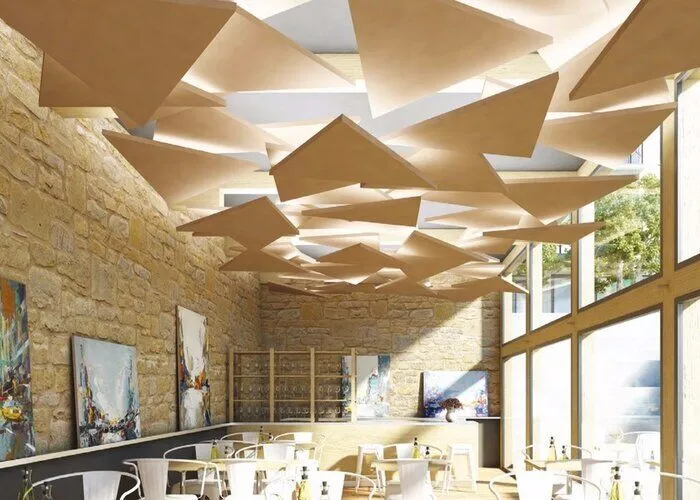
Noise has become a common challenge in modern buildings, especially in open offices, educational institutions, commercial spaces, and public facilities. Excessive sound reflections can reduce productivity, affect communication, and create an uncomfortable environment. This is where Acoustical ceiling clouds offer an effective and visually appealing solution.
What Are Acoustical Ceiling Clouds?
Acoustical ceiling clouds are suspended sound-absorbing panels installed below the main ceiling. Unlike traditional ceiling systems that cover the entire ceiling surface, these panels are strategically positioned to capture and reduce unwanted sound reflections. They are available in various shapes, sizes, and finishes, making them suitable for both acoustic performance and architectural aesthetics.
These acoustic elements help improve sound clarity by controlling reverberation and echo within a space. Their floating appearance also adds a modern design element to interiors.
How Acoustical Ceiling Clouds Improve Acoustic Performance
One of the primary functions of Acoustical ceiling clouds is to absorb sound waves before they bounce around a room. In large open spaces with hard surfaces such as glass, concrete, and metal, sound can travel freely and create excessive noise levels. Ceiling clouds help minimize this problem by reducing reverberation time and improving speech intelligibility.
By strategically placing Acoustical ceiling clouds, facility managers and architects can create more comfortable environments where conversations are clearer and background noise is significantly reduced.
Applications of Acoustical Ceiling Clouds
The versatility of Acoustical ceiling clouds makes them suitable for a wide range of environments. Common applications include:
- Corporate offices
- Conference rooms
- Educational institutions
- Healthcare facilities
- Restaurants and cafeterias
- Auditoriums and public buildings
- Commercial and retail spaces
These installations are particularly beneficial in open-plan environments where controlling noise is often a challenge.
Design and Aesthetic Benefits
Beyond acoustic performance, Acoustical ceiling clouds contribute significantly to interior design. They are available in different colors, geometric shapes, and customized configurations that complement modern architectural concepts.
Designers often use these ceiling elements to create visually striking ceilings while maintaining optimal acoustic comfort. Their suspended installation can add depth and dimension to otherwise plain ceiling areas.
Factors to Consider When Choosing Acoustical Ceiling Clouds
Selecting the right Acoustical ceiling clouds depends on several factors, including room size, ceiling height, noise levels, and aesthetic requirements. Material quality, sound absorption ratings, durability, and installation methods should also be evaluated carefully to achieve the desired acoustic performance.
Proper planning ensures that the system delivers both functional and visual benefits over the long term.
Reliable Acoustic Solutions from SomNandi Industries
Organizations seeking high-performance acoustic treatments often rely on solutions from SomNandi Industries. With a focus on quality engineering and innovative designs, SomNandi Industries provides acoustic products that help create quieter, more productive, and aesthetically pleasing environments.
Conclusion
As modern architecture increasingly favors open and collaborative spaces, effective sound management becomes essential. Acoustical ceiling clouds provide an efficient way to reduce noise, improve speech clarity, and enhance interior aesthetics. Their combination of acoustic performance and design flexibility makes them a preferred solution for a wide variety of commercial and institutional applications.