
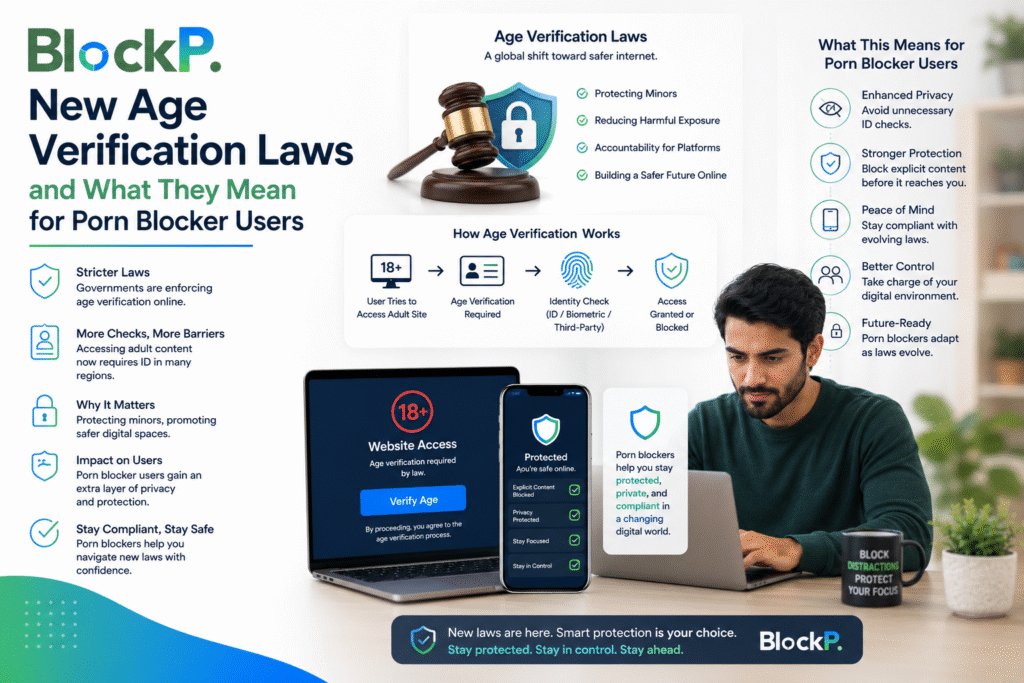
In 2026, age verification has become one of the most widely debated topics in digital policy. Governments across multiple regions are introducing or strengthening rules that require websites hosting adult content to verify that users meet legal age requirements before accessing certain material.
Supporters argue these measures are necessary to better protect children from exposure to explicit content. Critics raise concerns about privacy, data collection, and the potential impact on adults’ rights to access legal content anonymously.
As these discussions continue, many internet users are asking a practical question: what do these laws actually mean for individuals who already use porn blockers or digital wellness tools?
The answer is that age verification laws and personal content blockers serve different purposes. While legislation focuses on platform-level responsibilities, personal blockers focus on individual choice and self-directed online boundaries.
Understanding the distinction is important as governments, technology companies, families, and users navigate a rapidly changing online environment.
The Global Trend Toward Age Verification
Age verification requirements are becoming increasingly common worldwide.
Over the past several years, policymakers have expressed growing concern about children’s access to age-restricted content online. In response, multiple countries and jurisdictions have introduced or expanded rules requiring stronger age checks for adult websites and other online services. The trend reflects a broader movement toward online child safety and age-appropriate digital experiences.
Recent developments in Europe, the United Kingdom, Australia, and parts of the United States illustrate how age assurance has moved from policy discussions into active implementation and enforcement. Requirements vary considerably between jurisdictions, but the overall direction is clear: governments are placing greater responsibility on platforms to prevent minors from accessing adult content.
What Is Age Verification?
Age verification refers to methods used to determine whether a user meets the minimum age required to access specific content or services.
Different systems may rely on:
- Government-issued identification
- Third-party verification services
- Credit card checks
- Digital identity systems
- Age estimation technologies
- Privacy-preserving age assurance methods
Importantly, not all age verification systems work the same way.
Some verify identity directly.
Others focus only on confirming age eligibility without revealing additional personal information.
Recent policy discussions increasingly emphasize privacy-preserving approaches that allow users to prove they are old enough without unnecessarily exposing personal data.
Why Governments Are Pursuing These Laws
The primary goal behind age verification laws is child protection.
Research and policy reports consistently highlight concerns about minors encountering explicit material online, often at increasingly young ages. Governments, regulators, and child-safety organizations have therefore focused on mechanisms that reduce access to age-restricted content.
Policymakers generally argue that online environments should provide protections similar to those that already exist offline for age-restricted products and services.
While implementation methods vary, the objective is broadly consistent:
Protect children from content deemed inappropriate for their age.
Why Privacy Concerns Remain Part of the Conversation
Although child safety receives widespread support, privacy concerns remain an important part of the debate.
Critics worry that age verification systems may create situations where sensitive browsing activities become connected to personal information.
Questions frequently raised include:
- How is user data stored?
- Who processes verification requests?
- How long is information retained?
- Can systems be compromised?
- What protections exist against misuse?
Researchers, digital rights advocates, and policymakers continue exploring ways to balance effective child protection with privacy and anonymity for adult users. Several recent discussions and studies have highlighted the importance of designing age assurance systems that minimize unnecessary data collection while still meeting regulatory goals.
Child Safety and Adult Rights Are Not Opposing Goals
Public discussions sometimes present child protection and privacy rights as competing interests.
In reality, many experts view both objectives as important.
Children deserve safer online environments.
Adults deserve reasonable privacy and autonomy when accessing legal content.
The challenge for policymakers is finding solutions that effectively protect minors without creating excessive surveillance or unnecessary barriers for adults.
This balance has become a central theme in age verification debates across multiple countries.
Where Personal Porn Blockers Fit In
This is where personal content blockers enter the discussion.
Unlike government regulations or platform-mandated age gates, personal blockers are voluntary tools chosen by users themselves.
Their purpose is different.
Age verification laws attempt to prevent underage access.
Personal blockers help individuals shape their own online experiences.
People use blockers for many reasons:
- Digital wellness
- Productivity
- Family safety
- Personal values
- Habit management
- Reducing unwanted exposure
Rather than being imposed externally, these tools are generally adopted because users decide they want greater control over their digital environment.
A Complementary Rather Than Competitive Approach
Age verification laws and personal blockers are often discussed separately, but they can be complementary.
For example:
A government policy may require websites to verify users’ ages.
At the same time, an adult user may voluntarily choose additional filtering tools for personal reasons.
Similarly, parents may use content filters to create age-appropriate environments within their households regardless of broader legal requirements.
These approaches address different layers of the online ecosystem.
One operates at the regulatory level.
The other operates at the individual or family level.
Why More Users Are Choosing Personal Filters
The rise of digital wellness awareness has expanded interest in content blockers beyond traditional use cases.
Today’s users include:
- Parents
- Students
- Professionals
- Couples
- Digital minimalists
- Individuals pursuing healthier online habits
Many people are no longer viewing blockers solely as tools for recovery or restriction.
Instead, they are increasingly viewed as tools for intentional technology use.
Solutions such as BlockP illustrate how personal content-filtering tools can complement broader online safety efforts by helping users establish self-directed digital boundaries that align with their goals and preferences.
The Future of Age Assurance
The age verification landscape will likely continue evolving over the next several years.
Emerging developments include:
- Privacy-preserving age verification
- Anonymous proof-of-age systems
- Digital identity frameworks
- Improved age estimation technologies
- Enhanced regulatory standards
The European Union, for example, has recently emphasized privacy-focused approaches that seek to balance child safety and data protection simultaneously.
While implementation challenges remain, the overall direction suggests continued innovation in both online safety and privacy protection.
Conclusion
Age verification laws are becoming an increasingly significant part of the digital landscape. Governments across multiple regions are introducing measures aimed at reducing minors’ access to adult content, while ongoing debates continue around privacy, data protection, and implementation methods.
For users of porn blockers and digital wellness tools, these legal developments do not replace personal choice. Instead, they operate alongside it. Age verification focuses on platform-level compliance, while personal blockers help individuals and families create online environments that reflect their own goals, values, and preferences.
As online safety discussions evolve, the most effective solutions will likely be those that protect children, respect adult rights, preserve privacy, and empower users to make informed decisions about their digital lives.
Frequently Asked Questions
What are age verification laws trying to achieve?
Age verification laws are primarily designed to prevent minors from accessing age-restricted online content, including pornography and other materials deemed inappropriate for children. They aim to create safer digital environments while encouraging platforms to take greater responsibility for age-restricted access.
Do these laws affect adult privacy?
Potentially, depending on how verification systems are designed and implemented. Privacy concerns are one of the central issues in ongoing policy discussions. Many governments and technology providers are exploring privacy-preserving methods that verify age without unnecessarily collecting or storing personal information.
How do personal blockers differ from government-mandated filters?
Government-mandated systems are generally designed to enforce legal age restrictions across platforms. Personal blockers are voluntary tools chosen by individuals or families to manage their own online experiences, digital habits, productivity goals, or content preferences. They focus on personal choice rather than regulatory compliance.