
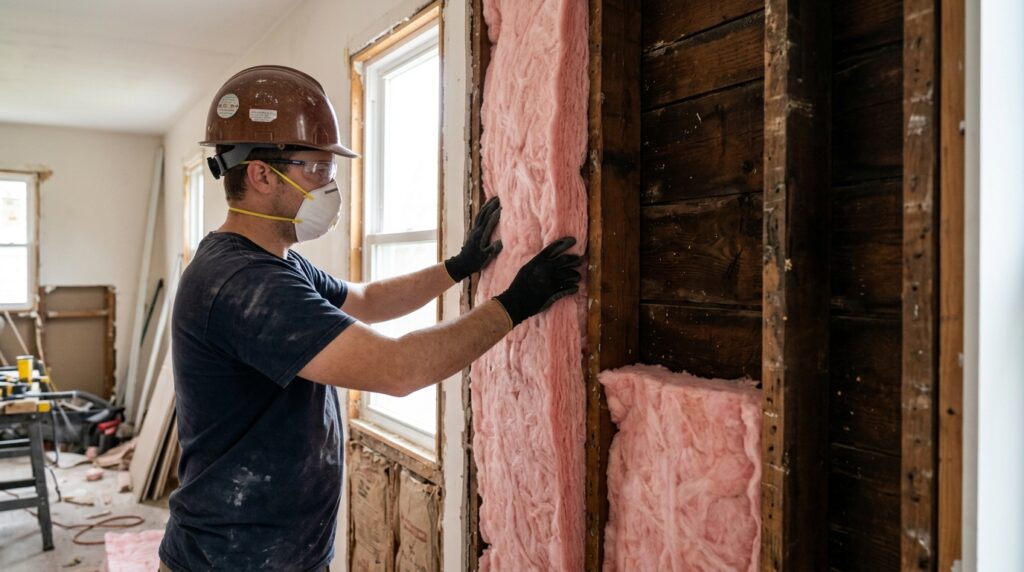
Yes, you can insulate a house with existing walls without tearing them down. One of the most commonly used methods in America is the drill-and-fill technique. This involves making small drill holes in the walls and then blowing in the insulation material like cellulose or foam. This increases energy efficiency, reduces utility expenses, and results in more comfortable homes all year long.
Wall insulation in many old homes, especially those built before the implementation of stringent energy codes, has either been nonexistent or inadequate in many American neighborhoods. Nowadays, rising heating and cooling prices have made insulation upgrades a rational decision and even an investment for homeowners. No matter if you live in a cold northern state or a hot southern region, better wall insulation can give you a big cut in your energy losses. Some homeowners even hire a construction cost estimator to gain a clearer picture of their expenses and potential savings before going ahead.
Understanding Existing Wall Conditions
You should know what your walls are made of before installing insulation. The majority of houses in America have stud-framed cavity walls, which means there are spaces between the wooden studs that can be filled with insulation. There may be some older houses with partial or no insulation.
Typically, contractors will start the process by checking the walls either by making small test holes or using thermal imaging tools. This allows them to find out if there is insulation and if it is in good condition. Besides that, moisture counts as a major factor as well. If any kind of water damage, mold, or leakage is found, those problems need to be fixed first before putting in insulation. Otherwise, putting insulation over wet walls can cause hidden moisture that may result in very expensive damage later.
The Main Insulation Methods For Already Constructed Walls
Blown-in Cellulose Insulation
This is the most common insulation method in the U.S. The cellulose insulation is made from recycled paper material. The paper is processed to be fire-resistant.
It is dense and fills wall cavities uniformly, which is great for retrofit jobs.
Injection Foam Insulation
Foam insulation is injected as a liquid, and after that, the foam expands, closing up air gaps and giving a really high insulation value.
This type of insulation is usually implemented in houses that have issues with air leakage.
Fiberglass Loose-Fill Insulation
Fiberglass is the least expensive type and is suitable for the main applications.
On the other hand, the sealing of air leaks with fiberglass is not as good as with foam.
Rigid Foam Board (Use Inside/Outside)
Sometimes, rigid foam boards are installed on the inside or the outside of the walls.
This is not a very popular way of insulating for the purpose of a retrofit, but in fact, it is one of the most highly performing insulation methods.
Installation Techniques
The drill-and-fill technique is the most common method in the U.S. Homeowners drill several small holes in the wall cavities between the studs and fill the rooms with insulation material. Once done, the small holes are closed and painted properly so that the changes stay almost invisible.
Generally, there are two options:
- Using inside means you will have to attach the drill to the drywall for wall insulation.
- Accessing outside means you will be doing all the drilling work through the siding.
Doing it inside manually can be a great option for houses that are already completed; however, doing it outside can be the main preference for those changing the siding of their homes. Dealers and suppliers usually do the work to your comfort, in case you mess up at the filling part of your wall or harm the wall structure.
Top Energy Efficiency And R-Value Guide
In America, one of the standard ways used for measuring the quality of insulation is the R-value, which quantitatively refers to how much a product can resist the flow of heat. The greater the R-value, the better an insulating product is obtained.
From state to state, the insulation norm varies for the different types of weather there. As an instance, for the cold climate states like Minnesota, houses are built to higher R-levels, whereas in a warm climate state like Florida, the R-value requirement is lower to an extent. For any climate zone, the Department of Energy in the U.S. acts as a harbinger of minimum required R-values.
Good insulation will greatly help you in cutting down your utility costs as well as keep your home warm and cozy by making sure that the temperature inside the house remains constant without any major fluctuations.
Materials Estimation And Project Planning
Insulation projects cannot do without accurate timing and planning. Usually, professionals depend on the process of insulation takeoffs to figure out the quantity of the wall material needed. Such a method helps in convincing homeowners that they are neither paying for unnecessary materials nor will they run out of them during the installation process.
All measurements are determined by the total wall area, depth of the cavity, and the type of insulation material. Good planning also allows you to compare the prices of different types of insulation and select the one that perfectly matches your home’s energy efficiency.
American Insulation Costs And Returns
Wall insulation costs for remodelling jobs differ according to the type of material used, labor, and the size of the house. Generally, homeowners in the U.S. should expect:
| Insulation Type | Average Cost (per sq. ft.) | Key Benefit |
| Blown-in cellulose | $1.50 – $3.00 | Affordable and eco-friendly |
| Injection foam | $3.00 – $5.00 | Best air sealing performance |
| Fiberglass loose-fill | $1.50 – $2.50 | Budget-friendly option |
Insulation upgrades indeed require a decent amount of money as an initial investment; however, in most cases, the savings you make on energy bills in a few years will be worth it. Besides, if you’re a homeowner in the United States, you may even be able to benefit from tax credits at a federal level or rebates from your local utility company, which will decrease the net cost of your investment significantly.
Common Problems And Mistakes
One of the common errors that homeowners make is not air sealing before installing insulation. Even the tiniest holes around windows, doors, or electrical wiring can make the insulation less effective.
Besides, the problem is that people put insulation in their walls without considering that the walls might be wet or damaged. Without fixing the moisture problems first, the walls will develop mold, which is very unhealthy. Also, stuffing insulation too tightly is something that happens often. This will lead to extra pressure, causing the drywall to break.
You will be able to stay clear of these situations if you hire someone who is trained and knows what they are doing, since they will do the job the right way.
Additional Efficiency Improvements
Wall insulation will have a greater effect only as part of a whole-house approach to energy efficiency. In the majority of U.S. homes, it has been found that the attic accounts for the most heat loss, followed by the walls and basements.
Further increases in energy efficiency can be achieved by sealing air leaks at the windows, doors, and ductwork. Putting in energy-efficient insulation in all areas of the house will not only make the indoor temperature more pleasant but will also put less pressure on your heating and cooling appliances.
Conclusion
Insulating walls that are already installed is a great way to make homes in the U.S. more energy-efficient. Thanks to drilling and foaming techniques, for instance, it is no longer necessary for the homeowner to strip the walls of drywall when upgrading the insulation using the most modern materials like foam and cellulose.
Learning about how your walls are built, making a wise choice of materials, and getting a good plan for the work will help you build a more comfortable and energy-efficient home, while you will be saving money in the long term.
FAQ
1. Which Insulation Is Best For Already Built Walls?
In the US, both blown-in cellulose and injection foam are mostly used. The reason is that they can easily fill up the cavities of walls without removal.
2. Is It Possible To Insulate Walls Without Removing Drywall?
It is possible. The method of drilling and filling enables insulation to be added with minimum disturbance.
3. How Much Is It To Insulate Existing Walls?
The price may vary between $1.50 to $5.00 per square foot, depending on what material you choose.
4. Is It Advisable To Insulate Walls In Mild Weather Areas?
Yes, even in moderate climates, insulation helps reduce energy bills and improve comfort.
5. Are There Government Incentives For Insulation?
Yes, many U.S. homeowners qualify for federal tax credits and local energy rebates.