
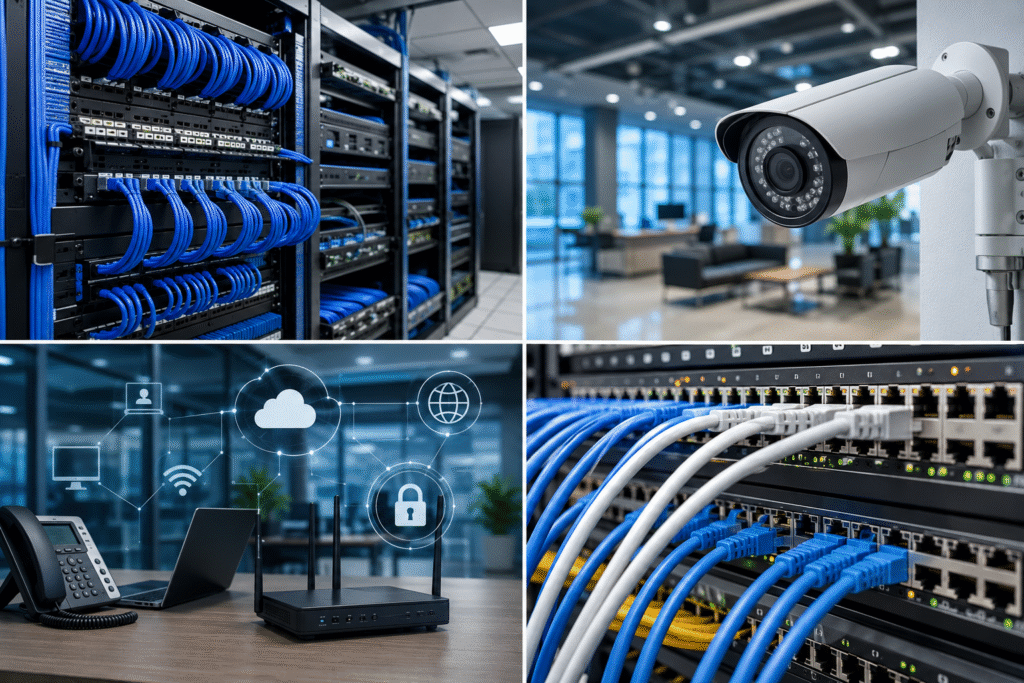
Technology has become the backbone of modern business operations. Every organization, regardless of its size or industry, relies on a dependable technology infrastructure to maintain productivity, protect valuable information, and support communication across departments. From computers and cloud applications to surveillance systems and structured networks, every technology component must work together to create a secure and efficient business environment.
Companies today face increasing challenges, including cyber threats, network downtime, data loss, equipment failures, and rising customer expectations. These challenges make it essential to build a technology infrastructure that is not only reliable but also scalable for future growth. Businesses that invest in well-planned IT systems, professional security solutions, organized cabling, and high-speed connectivity experience fewer disruptions, lower maintenance costs, and greater operational efficiency.
Rather than treating each technology system as a separate investment, organizations should adopt a unified approach that integrates IT support, surveillance, networking, communication, and physical security into one comprehensive infrastructure. This strategy improves performance while simplifying maintenance and reducing long-term costs.
This guide explains how modern businesses can create a reliable technology foundation through professional IT management, security systems, structured cabling, and robust connectivity solutions.
Why Technology Infrastructure Matters
Technology supports nearly every aspect of daily business operations. Employees depend on computers, cloud applications, internet connectivity, communication platforms, printers, wireless networks, and business software to perform their responsibilities efficiently. Even a brief interruption can affect customer service, productivity, sales, and overall profitability.
A strong technology infrastructure minimizes these risks by ensuring systems remain available, secure, and optimized for business performance. It also enables organizations to adapt quickly to changing business requirements without requiring major infrastructure replacements.
Organizations with well-designed technology systems often experience improved collaboration, better customer experiences, reduced downtime, and greater confidence in their ability to support future expansion.
The Role of Professional IT Management
Managing modern technology environments requires more than repairing computers when problems occur. Businesses must continuously monitor networks, maintain servers, update software, secure endpoints, manage cloud services, and provide technical support for employees.
Proactive IT management focuses on preventing problems before they interrupt business operations. Continuous monitoring allows technicians to identify hardware failures, software issues, security vulnerabilities, and network performance concerns before they become major operational challenges.
Organizations also benefit from predictable technology costs, improved compliance, stronger cybersecurity, and access to experienced technical professionals who understand evolving business requirements.
Businesses looking for long-term technology stability often rely on managed it services Columbus to maintain networks, monitor infrastructure, strengthen cybersecurity, support cloud technologies, reduce downtime, and provide proactive technical assistance without the expense of maintaining a large internal IT department.
Creating a Secure Business Environment
Physical security remains an essential part of every business infrastructure strategy. Offices, retail stores, warehouses, healthcare facilities, educational institutions, and industrial buildings all require protection against unauthorized access, theft, vandalism, and property damage.
Modern security systems combine multiple technologies including surveillance cameras, access control, alarm systems, visitor management, remote monitoring, and intelligent analytics. These systems provide real-time visibility while allowing business owners to respond quickly whenever unusual activity occurs.
An integrated security approach also improves employee safety while helping organizations comply with industry regulations and insurance requirements.
Effective physical security begins with evaluating potential vulnerabilities, identifying high-risk areas, and selecting technologies that provide comprehensive protection without disrupting normal business operations.
The Value of Video Surveillance
Video surveillance has evolved from simple recording systems into intelligent security platforms capable of supporting business operations in many different ways. High-definition cameras provide clear evidence during investigations while helping managers monitor facilities, improve safety, and verify operational procedures.
Modern surveillance systems include features such as remote viewing, motion detection, artificial intelligence, facial recognition, cloud storage, license plate recognition, and mobile alerts. These capabilities allow businesses to monitor multiple locations while maintaining complete visibility of their operations.
Organizations seeking reliable surveillance solutions frequently partner with security camera installation companies that design customized camera systems, optimize equipment placement, integrate recording platforms, and ensure dependable long-term performance across commercial environments.
Combining surveillance technology with access control and alarm systems creates multiple layers of protection that significantly reduce security risks.
Building a Reliable Network Infrastructure
Network infrastructure forms the communication backbone of every connected business. Computers, cloud applications, wireless access points, surveillance cameras, printers, servers, VoIP phones, and smart devices all depend on fast and stable network connectivity.
Poorly organized networks often experience communication failures, reduced performance, complicated maintenance, and higher operational costs. As businesses continue adopting cloud technologies and connected devices, reliable networking becomes increasingly important.
Professional network design ensures that every device communicates efficiently while supporting future technology expansion. Proper planning also reduces bottlenecks, improves cybersecurity, and simplifies troubleshooting.
Organizations should consider bandwidth requirements, redundancy, wireless coverage, equipment placement, and future scalability when designing their network infrastructure.
Organized Cabling Supports Long-Term Growth
Structured cabling provides a standardized network infrastructure capable of supporting voice, data, video, wireless networking, surveillance systems, and building automation technologies. Unlike traditional point-to-point wiring, structured cabling creates an organized environment that simplifies maintenance while supporting future expansion.
Businesses benefit from clearly labeled cable pathways, centralized communication rooms, professional patch panels, and standardized installation practices that reduce downtime whenever changes become necessary.
Professional structured cabling companies Columbus help organizations design scalable network infrastructure that improves communication reliability, supports surveillance systems, enables cloud connectivity, simplifies maintenance, and prepares facilities for future technology upgrades without requiring major rewiring projects.
Organized cabling also improves airflow within communication rooms while reducing accidental cable damage and simplifying equipment replacement.
Business Connectivity and Cloud Technologies
Reliable internet connectivity has become essential for nearly every business process. Cloud software, video conferencing, remote work, customer relationship management platforms, online transactions, and collaboration tools all require dependable network performance.
Modern organizations increasingly adopt hybrid work environments that allow employees to access business resources securely from multiple locations. Cloud computing supports this flexibility while reducing infrastructure costs and improving business continuity.
Businesses should evaluate internet redundancy, firewall protection, wireless performance, bandwidth capacity, and cloud integration when planning their connectivity strategy. These factors contribute directly to employee productivity and customer satisfaction.
Reliable connectivity also enables organizations to deploy new technologies more efficiently while supporting continuous digital transformation initiatives.
Best Practices for Maintaining Technology Infrastructure
Technology investments require ongoing maintenance to ensure long-term performance and security. Preventive maintenance helps identify potential problems before they affect daily operations while extending equipment lifespan.
Organizations should establish regular maintenance schedules that include software updates, security patching, hardware inspections, network monitoring, backup verification, cybersecurity assessments, and user access reviews.
Some important maintenance practices include:
- Monitor network performance continuously.
- Install security updates promptly.
- Test backup and disaster recovery procedures.
- Review cybersecurity policies regularly.
- Inspect surveillance equipment periodically.
- Document network infrastructure.
- Evaluate future technology requirements annually.
Businesses that prioritize preventive maintenance experience fewer unexpected disruptions while reducing long-term operational expenses.
Planning for Future Expansion
Technology infrastructure should support business growth rather than limit it. As organizations expand, additional employees, devices, applications, cloud services, surveillance equipment, and communication platforms place greater demands on existing infrastructure.
Scalable planning allows businesses to add new technology without replacing their entire network. Modular equipment, structured cabling, enterprise-grade networking, cloud platforms, and flexible security systems provide long-term value while supporting continuous growth.
Forward-thinking organizations regularly evaluate emerging technologies to determine which investments align with their strategic objectives and operational needs.
Conclusion
Technology infrastructure is far more than computers and internet connections. It represents the complete ecosystem that enables businesses to communicate, collaborate, protect assets, serve customers, and operate efficiently. Reliable IT management, intelligent surveillance systems, organized cabling, and dependable connectivity work together to create a secure and productive environment that supports both current operations and future expansion.
Organizations that invest in professional planning, proactive maintenance, scalable infrastructure, and integrated technology solutions gain significant competitive advantages. They reduce operational risks, improve system reliability, strengthen security, and create a flexible foundation capable of adapting to changing business requirements.
By viewing technology as a long-term strategic investment rather than a collection of individual systems, businesses position themselves for sustainable growth, improved productivity, and greater resilience in an increasingly digital world.