
Let me start with something that might sound uncomfortable. Most Indian students pick London universities for one reason only—the city. They imagine themselves walking through central London, interning at Canary Wharf, living the international student dream. And then they arrive, and the rent eats their budget, the commute eats their time, and the university itself turns out to be fine but not exceptional.
The University of West London is a decent institution. It has its strengths, particularly in hospitality and nursing. But the University of Liverpool is a different category of university altogether. Not slightly different. Fundamentally different.
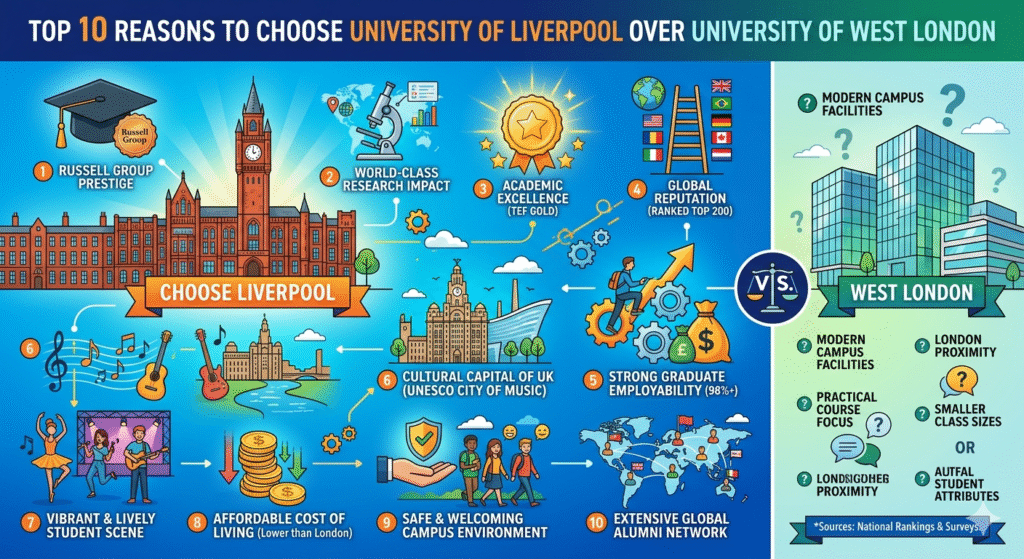
After placing hundreds of students at both universities, here are ten reasons Liverpool wins this comparison almost every time.
Why Choose University of Liverpool Over University of West London?
1. The Russell Group Difference
This is the single biggest distinction between these two universities. The University of Liverpool is a founding member of the Russell Group—the UK’s equivalent of the Ivy League. That means it ranks among the top 24 research-intensive universities in the country.
The University of West London is not a Russell Group member. That does not make it bad. But it does mean something specific for your CV. When employers in India, the UK, or anywhere else see University of Liverpool, they recognize the Russell Group badge. They may not know exactly what it means, but they know it means something. That recognition opens doors that a non-Russell Group university simply cannot.
2. Global Ranking Reality
Let me give you numbers because numbers do not lie.
The University of Liverpool consistently ranks in the top 200 globally across major ranking systems. QS World Rankings place it around 165-190 depending on the year. Times Higher Education places it in the 150-200 range.
The University of West London ranks in the 800-1000 range globally. That is not a small gap. That is a chasm.
Here is what that means practically. Many Indian companies have internal shortlists of preferred universities for campus recruitment. Liverpool makes those lists. West London rarely does. That is not opinion. That is observable pattern across years of placement data.
3. Research Output That Affects Your Teaching
Here is something students do not think about until they are sitting in a lecture. The quality of your teaching is directly connected to the research activity of your professors.
At a Russell Group university like Liverpool, your lecturers are active researchers. They are publishing papers. They are attending conferences. They are pushing the boundaries of their fields. That means your curriculum stays current. Your case studies are recent. Your professors can tell you what is changing in their industry right now, not what changed five years ago.
At West London, the focus is more on teaching than research. That is not a flaw—it is a deliberate positioning. But it means your professors may not be as plugged into the cutting edge of their disciplines. For some students, that is fine. For students who want to work in competitive fields like finance, law, or tech, it matters.
4. The Alumni Network Scale
The University of Liverpool was founded in 1881. It has produced nine Nobel Prize winners. Its alumni include CEOs, Supreme Court judges, and cabinet ministers across multiple countries.
The University of West London gained university status in 1992. Its alumni network is smaller, younger, and less globally distributed.
Here is what that means for you. When you graduate from Liverpool, you join a network of over 250,000 alumni worldwide. When you need an introduction, a referral, or advice, there is probably a Liverpool graduate in that city, at that company, in that role. West London simply cannot match that density and reach.
5. Liverpool City Cost of Living vs. London
Let me give you real numbers from actual students.
A room in a shared flat near the University of West London in Ealing or Brentford costs £900 to £1,300 per month. A similar room near the University of Liverpool costs £450 to £700 per month.
A monthly transport pass in London costs £150 to £200. In Liverpool, most students walk or cycle. When you need public transport, a local bus pass costs £60 to £80.
A meal out in London costs £20 to £30. In Liverpool, the same meal costs £12 to £18.
Over a three-year undergraduate degree, living in Liverpool instead of London saves you £15,000 to £25,000. That is not theoretical. That is actual money that stays in your pocket or reduces your education loan.
6. The Campus Experience
The University of Liverpool has a proper campus. Red brick buildings. Green spaces. Student union. Libraries open late. Sports facilities. It feels like a university.
The University of West London is a commuter university. Its main sites in Ealing and Brentwood are spread across multiple buildings integrated into west London neighborhoods. There is no central campus. No single place where students naturally gather.
This matters more than you think. The friendships you build in the student union bar, the late night library study sessions, the spontaneous conversations between classes—that is the university experience. Liverpool offers that. West London offers a more fragmented experience where students come for classes and then leave.
7. Specialization Strength Differences
Both universities have programs they are known for. But the weight of those reputations is different.
The University of West London is genuinely strong in hospitality management, music production, and nursing. If those are your fields, West London deserves serious consideration.
But the University of Liverpool is strong in everything else. Law, business, computer science, engineering, medicine, architecture, data science—Liverpool outperforms West London across virtually every other discipline.
For the vast majority of Indian students, who are pursuing business, STEM, or law degrees, Liverpool is objectively the stronger academic choice.
8. The International Student Support Systems
This is one area where experience teaches you things ranking tables miss.
The University of Liverpool has been hosting large numbers of international students for decades. They have mature systems for everything—visa advice, accommodation placement, language support, cultural integration. When something goes wrong, they have seen it before and they have a process to fix it.
The University of West London also supports international students well. But their volume is smaller and their systems are newer. The margin for error is larger.
We have had students at Liverpool with visa issues resolved in days. We have had students at West London with similar issues take weeks. That is not a criticism of West London. It is simply a function of institutional experience and scale.
9. Post-Graduation Earnings Data
Let me share data that UK government publications track but students rarely check.
Five years after graduation, the median salary for University of Liverpool graduates is consistently higher than for University of West London graduates across comparable programs. The gap ranges from £5,000 to £12,000 annually depending on the field.
For business graduates, the gap is approximately £8,000. For computer science, approximately £10,000. For law, approximately £9,000.
That means the higher-ranked university produces higher earnings. It is not guaranteed for every individual student. But the averages are clear. Over a career, that gap compounds into hundreds of thousands of pounds.
10. The Long-Term CV Value
Here is the honest truth that nobody likes to say out loud. Fifteen years into your career, nobody will ask you about your module choices or your dissertation topic. But they will see the name of your university on your CV.
University of Liverpool carries weight. It is a brand that says this person was competitive enough to get into a Russell Group university. University of West London does not carry that same weight. It is not a bad name. It is just not a name that adds points to your profile.
For students who plan to return to India, this matters enormously. Indian employers are brand-conscious. They know the Russell Group. They have heard of Liverpool because of its Nobel laureates and its global alumni. They have not heard of West London.
That does not mean you cannot succeed with a West London degree. You absolutely can. But you will succeed despite the brand, not because of it. With Liverpool, the brand works for you.
One Final Honest Note
The University of West London is a perfectly fine university. If your budget is extremely tight and staying in London is non-negotiable for personal reasons, West London will give you a degree and a path forward.
But the University of Liverpool offers a Russell Group education, a global alumni network, lower living costs, higher starting salaries, and a CV that opens doors. For the vast majority of Indian students, that combination is impossible to ignore.
Choose Liverpool for the long game. Choose West London if London itself is the priority and you understand the trade-offs you are making. Just do not pretend the trade-offs do not exist. They do. And they are significant.