
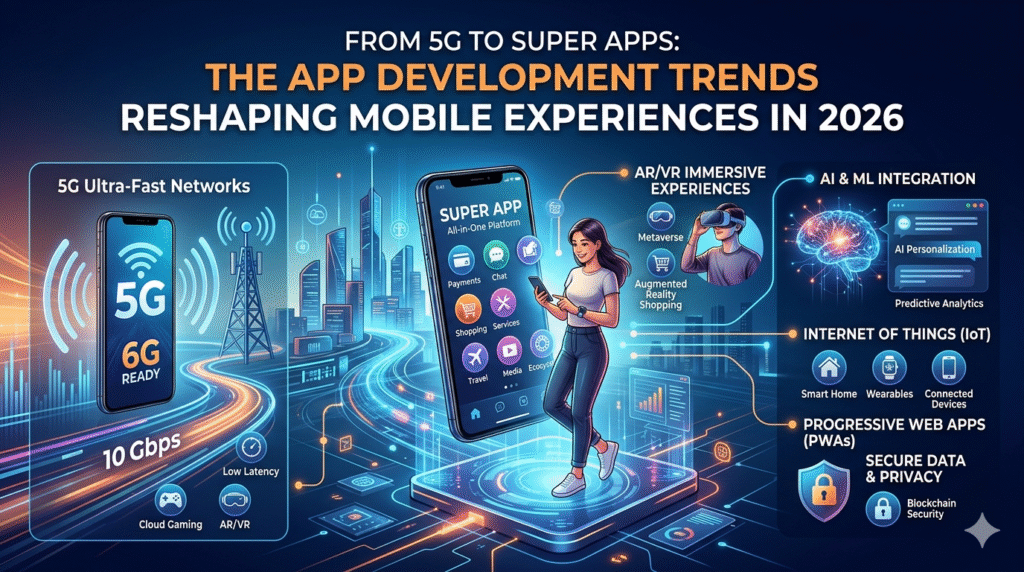
The mobile landscape in 2026 looks nothing like it did just three years ago. Faster networks, smarter AI, and shifting user behavior have converged to redefine what people expect from their phones — and from the teams building for them. Whether you’re a startup founder, a product manager, or a business owner eyeing the app market, understanding these trends is no longer optional. It’s the difference between launching something users love and shipping something they forget.
5G Is Finally Living Up to the Hype
After years of promises, 5G has matured into genuine infrastructure across major markets. Real-world speeds now consistently support low-latency video, cloud rendering, and real-time data processing at scale. This has cracked open use cases that were impractical before — remote AR collaboration, instant high-res media uploads, and seamless live commerce.
For any mobile app development company working in these verticals, 5G is no longer a “future consideration.” It’s the baseline architecture assumption shaping how features are scoped and how performance benchmarks are set. Apps that were once constrained by bandwidth can now deliver desktop-grade experiences on a handset — and users have noticed.
The Rise of the Super App Model
Perhaps the most disruptive trend in mobile right now is the consolidation of services into so-called “super apps.” Inspired by the success of WeChat and Grab in Asia, Western markets are rapidly warming to the model. A single app now handles payments, food delivery, social features, ticketing, and customer support — all under one login.
For any app development company evaluating new product strategies, this model carries serious implications. Building in isolation is becoming a competitive disadvantage. Users want integrated ecosystems, not fragmented tool sets. The result is a design philosophy that prioritizes platform extensibility — apps built not just as products, but as launchpads for mini-apps and embedded services from third-party partners.
AI-Native Features Are Now Table Stakes
Two years ago, AI was a differentiator. In 2026, it’s an expectation.
Predictive text, personalized content feeds, intelligent search, and on-device AI assistants have shifted from premium to standard. Users now assume their apps know their preferences, surface relevant information proactively, and get smarter over time. The challenge for mobile application developers is no longer whether to implement AI — it’s how to implement it responsibly, efficiently, and in ways that genuinely serve users rather than just adding noise.
On-device inference, powered by dedicated neural processing chips, is also reshaping the privacy conversation. Running AI locally rather than in the cloud means sensitive user data stays on the device, which is fast becoming a meaningful trust signal for privacy-conscious consumers.
Cross-Platform Development Has Grown Up
The fragmentation problem that once plagued cross-platform frameworks has largely been solved. Flutter, React Native, and newer entrants have matured to the point where performance parity with native development is achievable for most application types.
For businesses looking to maximize their development budget, this is significant. A skilled mobile app development company today can ship a high-quality product across iOS and Android simultaneously, with a single codebase, without meaningful compromises in user experience. The cost efficiency and speed-to-market advantages are too substantial for most organizations to ignore.
Hyper-Personalization Through Contextual Intelligence
Beyond AI recommendations, the 2026 mobile experience is defined by contextual awareness. Apps now adapt based on time of day, location, device usage patterns, and even ambient signals like weather or calendar context. This is hyper-personalization — not just knowing who you are, but knowing what you need right now.
Building this kind of contextual intelligence requires a rethinking of how data pipelines are structured and how user permissions are handled. The most forward-thinking mobile application developers are investing heavily in behavioral modeling, edge computing, and privacy-first data architectures to power these experiences without alienating users.
Sustainability and Ethical Design Are Gaining Ground
A quieter but increasingly important trend is the push for sustainable and ethical app design. Battery consumption, data efficiency, screen time transparency, and algorithmic fairness are now topics that appear in product roadmaps, not just academic papers.
Regulators in the EU and several other markets have begun introducing digital ethics frameworks, and enterprise clients are increasingly asking vendors about responsible design practices. An app development company that can demonstrate a clear approach to ethical product development is gaining ground — both reputationally and commercially.
What This Means for Businesses in 2026
The mobile opportunity is enormous, but the bar for entry has risen. Users are more demanding, the competitive landscape is more crowded, and the technical complexity of building meaningful mobile experiences has increased substantially.
The businesses succeeding in this environment share one thing: they’re working with partners who understand not just code, but strategy. Choosing the right mobile app development company — one with experience across AI integration, cross-platform architecture, and emerging connectivity standards — is one of the most consequential decisions a digital product team can make this year.
The trends are clear. 5G, super apps, on-device AI, and hyper-personalization are not emerging forces — they’re already here, already shaping user expectations, and already separating the apps people open daily from the ones they uninstall. The question for every business is simple: which side of that line do you want to be on?
Ready to build something that stands out in 2026? Partner with experienced mobile application developers who understand where the market is heading — and how to get you there first.